A two-person exhibition by curator Yoon Minhwa and visual artist Choi Taehoon
The ‘chair’ set as the object representing the category of things
Perigee Gallery presents Perigee Team Project 2020 <Tractor>, on view through February 6, 2021.
<Tractor> is a two-person exhibition by curator Yoon Minhwa and visual artist Choi Taehoon. Having met through the Perigee Team Project, the two set a single theme together over the past year and then approached it in their respective ways—Yoon Minhwa through text and Choi Taehoon through sculpture.
The project began with the process of pinpointing a common theme for the exhibition. The theme could be settled through a process of discovering the points where the two participants’ ongoing creative practices from the past both connect and intersect, and then adding theoretical, formal, and timely validity to those points.
In this exhibition, the relationship between Yoon Minhwa and Choi Taehoon is like a river and a bridge. They are two straight lines crossing in different directions, yet they never directly meet, and inevitably the existence of the other becomes the reference point for one’s own characteristics.
Yoon Minhwa and Choi Taehoon imagine a tractor (a towing vehicle) that draws out new forces and directions between things and people. This invisible force and direction presumes a state in which things are not subjugated by humans, and it also invents a situation in which the human body, too, is not subordinated to the functions of things.
In the past, industrial design developed through approaches based on the scale and proportions of the human body, standard dimensions, and ergonomics. The shapes and sizes of things were standardized on the basis of the human body, but conversely the human body and ways of living are also being drawn along to fit the functions of things. Things designed for the sake of function and efficiency are not free from human body dimensions and proportions, and the bodies of people who passively use ready-made products are likewise fixed by the design of things.
The human body added a standard to the design of things, and things thus standardized fix the body in particular ways. In the exhibition, the two participants imagine yet another force and direction between things and people. To this end, they detach things from the productivity of the ready-made and liberate people from the status of user.
Yoon Minhwa and Choi Taehoon set the chair as the object representing the category of things. And they posited people who, at a certain moment, came to find the chair unfamiliar. These are people who feel a discomfort from things. No—unlike simple discomfort, they are people who complain of a certain sensation that is hard to explain precisely in words.
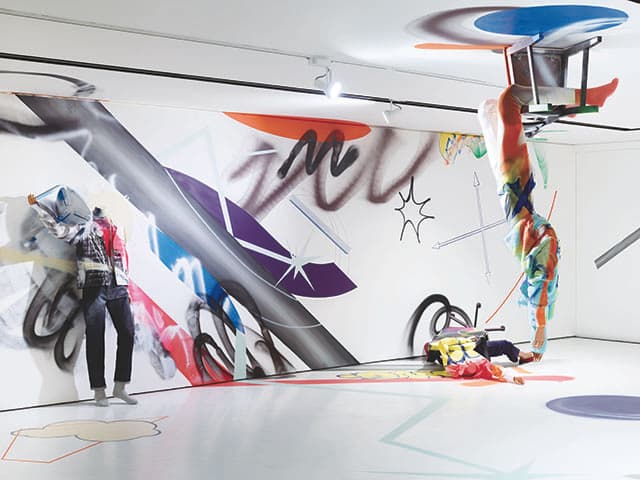
Though the cause is not clearly given either, those who in their own ways have sensed a “feeling that something doesn’t fit me” strip the chair of its original function and bind it to their own bodies. The six bodies encountered in the exhibition space reveal a schismatic situation in which, in order to join with the chair as an object, they instead become detached—seemingly attached yet separated, and thereby alienated—as they interlock with the chair.
Originally, a chair is used for its proper purpose when a person, relying on gravity, folds the pelvis and legs to sit. But between the six faceless sculptures of the human body and the six chairs spread throughout the exhibition space, a different tension is at work.
The condition of the ‘tractor’ as a towing device, which the title suggests, intervenes, making us imagine a force that exerts its influence differently from gravity. This is closer to a kind of motility that reacts independently of one’s will, like an allergy or a tic. In the end, the strange correspondence between force, thing, and person simultaneously triggers a reflection on the fundamental function of ‘things’ and an unfamiliar sensation regarding the ‘body.’
Taking the imaginary machine called ‘tractor’ as a towing apparatus that generates these complex layers, Yoon Minhwa produces text work on the aesthetic effects and capacities that arise in things when the human being is made to slip from the central place where it originally stood, while Choi Taehoon creates, in sculpture, six thing-bodies that abandon the role of user and combine with things in strange ways, thereby instead becoming detached from them.
The action of the invisible force that gives poses to the human body and controls the movement between chair and body is indirectly made visible in the spray scattered across the exhibition space. The dimension of force in physics, the dimension of the formal qualities that things and bodies form, and the dimension of the sensations these trigger are, finally, made manifest before our eyes through the spray dispersed into the air. This suggests that the force we imagine does not exist somewhere outside beyond this world, but is entirely a matter within the world to which we belong—like a kind of scotoma that belongs yet is at the same time not incorporated. 070-4676-7091