Perigee Gallery, The Taste of Grapes — A Metaphor for the Artist's Own Work
The Reciprocal Relationship Between a Machine's Surface and Its Internal Apparatus
Perigee Gallery presents Jung Sung-yoon's solo exhibition <The Taste of Grapes>, on view through August 7.
Jung Sung-yoon is interested in the processes of a machine's internal apparatus that remain hidden from our eyes. This concern goes beyond the mere mechanics of operation to address the reciprocal relationship between the machine's surface and its internal apparatus. And this, in turn, encompasses the way the work connects with the viewer who beholds it.
The machine surface to which the artist draws attention here is one where the output generated by the apparatus he has devised remains uncontrolled, appearing and disappearing momentarily in irregular forms. For this reason, his work reads as a sculptural performance that lends flexibility to the rigid machines we perceive.
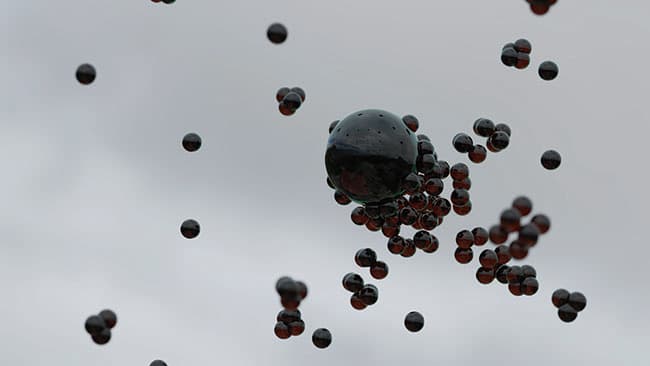
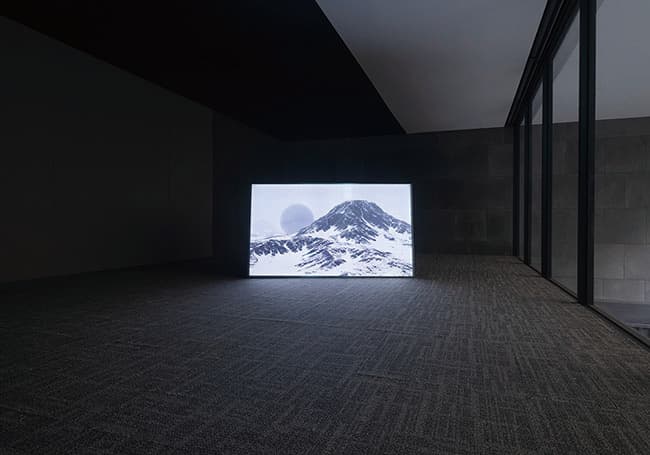
The title of this exhibition is <The Taste of Grapes_ a mucous membrane>, and it comprises four works: <Two Ellipses>, <Snake and Water>, <Rabbit>, and the video work <Amalgam>. The Korean title, The Taste of Grapes, refers to the texture of a grape's slick skin and to the sensations triggered by the flavor and smell of the flesh when it is placed in the mouth and peeled — a metaphor for the artist's own work.
The English title, by contrast, conveys the direct meaning of a sticky, translucent mucous membrane. In his work, the mechanical apparatus is at times revealed and at times concealed, and its outward appearance is at once ceaselessly moving and changing yet serene. Such movement arises as the interior and exterior of the machine connect and place importance on a mutual balance. The surface that interacts by means of the machine is, of course, produced by the manipulation in which the input values intended by the artist are carried out.
Yet Jung Sung-yoon is drawn to situations that stray from the artist's intention and cannot be perfectly controlled. This attitude suggests that, through the mechanical apparatus, the artist is not reproducing something but rather engaging in an act to produce something latent that has yet to appear. Thus, while the output as a work exists as a material expression, it is always mutable.
The mucous membrane the artist speaks of exists between the interior and the exterior, yet it is by no means a completely hardened, rigid frame. The mucous membrane mediates the process by which not only a single machine and the "self" but also countless objects connect with and separate from one another. If his previous work induced certain situations and prompted people to observe and perceive them, the work presented in this exhibition takes a further step, calling for time given over to meditative immersion for contemplation.
And the mucous membrane momentarily brings to light the space-time in which all things, tangible and intangible — including the human being — ceaselessly interact. To empathize with the space-time the artist has created, our body and mind must arrive at a light state in which they can contemplate while crossing between the interior and the exterior. Accordingly, the mucous membrane that emerges through the apparatus he builds does not remain a passive material but is an active tool that triggers a fluid state of ceaseless movement.
Through a freedom that traverses the antinomic ironies between human and machine, the notion of mind and the actual body, exterior and interior, control and error, the artist brings us to perceive a new world. In the end, the artist leads us into a time of contemplation so that, breaking free from one particular world, we may recognize with a broad and horizontal gaze all the beings of diverse strata that function as parts — including the "self." Through this, Jung Sung-yoon shows us that the time has come when a new imagination is needed for such a shift in perception. 070-4676-7096
▲ Installation view of Jung Sung-yoon's solo exhibition. <Two Ellipses>, <Rabbit>, <Snake and Water>